
Short answer: only when the extra spend creates sales that would not have happened anyway, and raises the company's long-term profit. ROAS, or return on ad spend, is the sales an ad platform credits to your ads for every RM1 spent. It shows what the ads were credited with, which is not always what they created. Incremental sales are the sales that would not have happened without the ads.
11.11 has just passed, and I have been thinking a lot about digital marketing.
In e-commerce today, especially on TikTok Shop and Shopee, everyone chases GMV and ROAS every day. Some brands start with ads that deliver a ROAS of 10 or 12, and the business is doing well. Then, to push GMV higher, they keep raising the ad budget. GMV does go up. But ROAS slides from 12 to 10 and 8, and sometimes all the way down to 6 or 7.
Is that the right thing to do?
Is a falling ROAS always a bad sign?
No. A lower ROAS can still be the right result, as long as the extra spend brings in extra profit. Take an example.
| Illustrative example | Ad spend and attributed sales | ROAS |
|---|---|---|
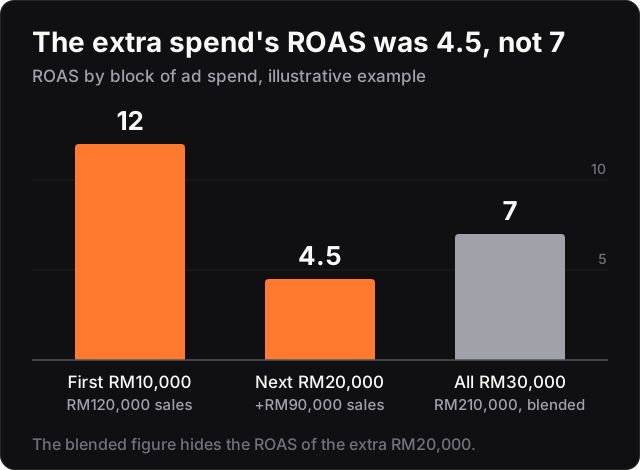
| Before | RM10,000 of ads, RM120,000 of sales | 12 |
| After raising the budget | RM30,000 of ads, RM210,000 of sales | 7 |
| The extra spend only | RM20,000 of ads, RM90,000 of sales | 4.5 |
ROAS fell from 12 to 7. That 7 is a blended ROAS, an average across the whole RM30,000, and it hides what the extra spend returned: the extra RM20,000 brought in another RM90,000 of sales credited to the ads, a ROAS of 4.5. If, after product cost, platform fees and the ad spend itself, the company makes more profit, the extra spend is worth it, even with a lower ROAS.
In this example, the extra RM90,000 of sales only pays back the extra RM20,000 of ads if more than about 22% of each of those sales is left after product cost and platform fees. On Shopee and TikTok Shop, basic platform fees alone already take roughly RM18.90 to RM22.68 of a RM100 Fashion order, so that bar is harder to clear than it looks.
But if the bigger budget is only there to push GMV higher, and profit does not rise, or even falls, then there is no reason to do it.
Are the sales in your ad dashboard really created by your ads?
Not always. An ad dashboard shows attributed sales, the sales the platform credits to your ads, and some of them would have happened without the ads. The calculation above rests on one assumption: that the sales shown in the ad dashboard were all really brought in by the ads.
Even large international brands have struggled with this. In October 2019, Adidas's global media director, Simon Peel, told a marketing effectiveness conference in London that the company had been over-investing in digital performance advertising and underestimating what brand building did for sales. Marketing Week reported that Adidas's own modelling showed brand activity drove about 65% of its sales across wholesale, retail and e-commerce, while only 23% of its advertising went to brand and 77% to performance.
In December 2024, on his first earnings call as Nike's CEO, Elliott Hill said the company had shifted investment away from creating demand for its brand towards capturing demand through performance marketing for its digital business, and that Nike would move money back into brand marketing.
Put simply, they had concentrated on turning existing demand into orders, and neglected how to create the demand of the future.
What is the difference between attributed sales and incremental sales?
Attributed sales are the sales an ad platform credits to your ads. Incremental sales are the sales that would not have happened without them.
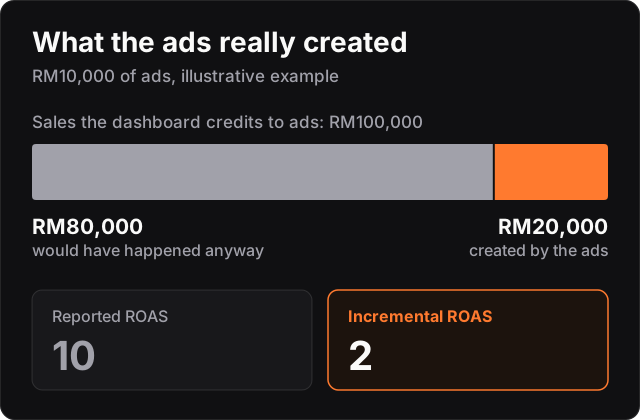
Suppose I spend RM10,000 on ads, and the dashboard says they brought in RM100,000 of sales. But what if, without that RM10,000, I would still have sold RM80,000?
| Illustrative example | Amount |
|---|---|
| Ad spend | RM10,000 |
| Sales the dashboard credits to ads | RM100,000 |
| Sales that would have happened anyway | RM80,000 |
| Sales the ads actually created | RM20,000 |
| Reported ROAS | 10 |
| Incremental ROAS | 2 |
Then the new sales the ads actually created may be only RM20,000, not RM100,000. Incremental ROAS is the sales the ads actually created for every RM1 spent: RM20,000 on RM10,000 of ads is an incremental ROAS of 2, against a reported ROAS of 10. That is the difference between ad attribution and real incrementality.
Does advertising create demand, or capture demand that already exists?
It does both, and in an ad dashboard the two can look almost the same. Take a blood pressure monitor brand we operate.
Someone with no need for one will not suddenly buy a blood pressure monitor because they saw an ad on 11.11. Far more often, the need was already there. An elderly parent needs one, a doctor recommended it, or they had been thinking about buying one for a while. Then 11.11 arrives, they see an ad and a discount, and they place the order.
But there are 2 possibilities here:
- The customer already planned to buy our brand, and the ad only reminded them to complete the purchase.
- The customer planned to buy another brand, and our ad made them choose us instead.
In the ad dashboard, these 2 orders may look almost the same. But the value the ad actually created is completely different.
So digital marketing matters. But the sales it brings in come from 3 different places:
- New demand that would not have existed without the ad.
- Demand won from competitors that would otherwise have gone to another brand.
- Orders that would have happened anyway, either at the same time, with the ad only reminding the customer, or later, pulled forward by the ad.
Do mega sales like 11.11 and 12.12 create new sales, or pull them forward?
Both. Mega sales like 11.11 and 12.12 bring some new orders, but some are purchases customers had planned for later and simply made earlier, which is why they deserve particular attention.
On the day, GMV jumps and the marketing looks like a big success. But how many of those orders were for things customers had planned to buy in December or January anyway, and simply bought earlier because of 11.11?
If November sales go up but the following months go down, how much did sales and profit for the whole quarter actually increase?
And for those orders, we also paid extra in advertising, discounts and other promotion costs.
Why can't a brand rely on performance marketing alone?
A brand cannot rely on performance marketing alone, meaning ads bought and judged on the sales a platform credits to them. Branding, product, content and customer trust all build up over time.
A customer may choose you today because they watched your content 3 months ago, used your product 6 months ago, or have simply liked your brand for a long time. Today they happened to complete the purchase through an ad, so the ad dashboard credited that sale to the ad.
If you only look at those numbers, you can overestimate what performance ads contribute, and overlook the other things that really shaped the customer's decision. We made a similar point about judging Shopee GMV Max on reported ROAS alone.
Branding and performance marketing are not completely separate, either. Good content, LIVE sessions and ads can build the brand and convert sales at the same time.
So is it right to grow GMV by raising your digital marketing budget?
If a bigger ad budget brings in real new sales and raises the company's long-term profit, a falling ROAS is not a problem.
But if you keep spending more money only to buy back orders that would have happened anyway, or give up profit just to grow GMV, it is worth rethinking. After all, what a business is ultimately after is not GMV, but profit and long-term growth. We made the same case in our post on chasing GMV growth.
So rather than the ROAS in the ad dashboard, the questions I care about more are these:
If I had not run this ad today, how much business would I actually have lost?
And is the extra ad spend making the company more money, or is it just buying sales that would have happened anyway, at a higher and higher price?
Frequently asked questions
What is the difference between ROAS and incremental ROAS?
ROAS is the sales an ad platform credits to your ads for every RM1 spent. Incremental ROAS, sometimes written iROAS, is the sales the ads actually created for every RM1 spent, counting only the sales that would not have happened without them. In this post's second example, RM10,000 of ads is credited with RM100,000 of sales, a ROAS of 10. If RM80,000 would have come anyway, the ads created RM20,000, an incremental ROAS of 2.
Is a falling ROAS bad when I increase my ad budget?
Not necessarily. ROAS often falls as the budget rises. What matters is whether the extra spend brings in extra profit. In this post's first example, raising spend from RM10,000 to RM30,000 lowered ROAS from 12 to 7, but the extra RM20,000 still brought in RM90,000 of attributed sales, a ROAS of 4.5 on the extra spend. It is worth it only if those sales are real and leave more profit after product cost, platform fees and the ads.
When does extra ad spend pay for itself?
When the sales it adds leave more, after product cost and platform fees, than the ad spend itself. In this post's first example, the extra RM20,000 of ads is credited with RM90,000 of sales, a ROAS of 4.5, so it pays back only if more than about 22% of each of those sales is left after product cost and platform fees. If some of those sales would have happened anyway, the share needed is higher.
Why can my ad dashboard overstate what my ads achieve?
An ad dashboard credits the ads with sales from shoppers who clicked or saw them within a set period, including customers who had already decided to buy and were only reminded by the ad. Brand content, past experience with the product and long-term trust all shape a purchase, but the dashboard gives the credit to the ad.
How do I measure whether my ads create incremental sales?
Ask what you would lose without them. One practical way to estimate it is to reduce or pause ads on some products for a few weeks, away from a mega sale and with prices unchanged, and compare their sales with similar products that kept the ads. The gap is a rough guide to the incremental sales the ads created, and dividing it by the ad spend you paused gives a rough incremental ROAS.
Do 11.11 and 12.12 sales create new demand?
Partly. Some orders are new and some are won from competitors, but some are purchases customers would have made in the following months anyway, pulled forward by the discount and the ads. Judge a mega sale on the whole quarter, not the day, and count the extra ad, discount and promotion costs.
Should brands stop performance marketing?
No. Digital marketing still matters, and good content, LIVE sessions and ads can build the brand and drive sales at the same time. The point is to measure it on the new sales and profit it creates, not on the sales the dashboard credits to it.
How can Labu-Labu help?
Labu-Labu is a Malaysia-based social-commerce and e-commerce enabler helping brands operate and grow across Shopee, TikTok Shop and other digital commerce channels. We look at ad spend, attributed sales, platform fees and profit together, so budget goes where it creates new sales rather than buying back sales you would have had anyway.
If you want to find out how much of your ad-attributed sales are really new, talk to us.