
Short answer: not at all costs. GMV, or gross merchandise value, is the total value of orders a brand sells before platform fees, advertising and other costs come off. When marketplace fees and advertising keep getting more expensive, more GMV does not automatically mean more profit. The better order is to work out how the business makes money first, and then decide how big it should be.
Recently, I had an interesting conversation with 2 successful Malaysian entrepreneurs. One is a well-known figure in the e-commerce industry. The other runs a food business that started online and has been expanding into offline retail over the past few years.
We ended up discussing a problem that almost every e-commerce brand in Malaysia is facing today: marketplace fees are getting more expensive.
Why are marketplace costs forcing brands to rethink growth?
Marketplace costs are forcing brands to rethink growth because commission, transaction fees, advertising, affiliate commission and promotional vouchers now take a growing share of every order on Shopee, TikTok Shop and Lazada. As we worked out in our breakdown of 2026 marketplace fees, a Fashion seller already pays roughly RM18.90 to RM22.68 in basic platform fees on every RM100 order on Shopee or TikTok Shop, and up to RM24.84 inside Shopee's Cashback Programme. That is before a single ringgit of advertising, affiliate commission or vouchers.
So, what should brands do? I shared a slightly different perspective:
Stop chasing volume.
My thinking is quite simple. If marketplace costs are getting too high, why are we still pushing so aggressively for GMV growth?
Control advertising spending, remove unprofitable sales, and focus on making every order commercially worthwhile. Even if GMV decreases, isn't it better to operate a profitable business?
Why did e-commerce brands get used to chasing GMV?
Many e-commerce brands got used to chasing GMV during the COVID-19 pandemic, and I think this has a lot to do with how the industry developed in that period.
During COVID-19, consumer behaviour shifted sharply towards online shopping. Marketplaces grew quickly, and for many brands, scaling was relatively straightforward:
- Increase advertising budgets.
- Generate more orders.
- Replenish inventory.
- Expand SKUs.
- Hire more people.
- Reinvest the revenue into further growth.
The cycle continued. And to be fair, that strategy worked during that period. We went through a similar phase ourselves.
Over time, many of us developed a particular mindset. If we achieved RM10 million in GMV this year, we should aim for RM20 million next year, followed by RM30 million.
Growth became an expectation.
Does more GMV still mean more profit?
Not automatically, and less often than it used to. Have we ever seriously asked ourselves why GMV must keep growing every year?
In the past, when platform fees were lower and traffic was relatively affordable, scaling sales could translate into stronger profits. Today, the economics have changed. Marketplace commissions have increased, advertising competition has intensified, and additional costs continue to put pressure on margins.
In many cases, sales are growing, but profits are not.
What happens when more ad spend stops bringing more sales?
When extra ad spend stops bringing extra sales, the additional budget mostly adds cost, and reported ROAS falls. Recently, another friend who runs a fashion business shared his experience with Meta advertising.
A few years ago, his campaigns could achieve a ROAS, or return on ad spend, of around 10. In other words, for every RM1 spent on advertising, Meta attributed approximately RM10 in sales. As competition increased, his ROAS gradually declined. Today it has stabilised at around 3 to 3.5.
What is more interesting is what happens when he tries to increase his advertising budget. Sales barely increase, but his reported ROAS can drop to around 2.
| His Meta campaigns | Reported ROAS | Sales attributed per RM1 of ads |
|---|---|---|
| A few years ago | Around 10 | About RM10 |
| Today | 3 to 3.5 | RM3 to RM3.50 |
| Today, with a bigger budget | Around 2 | About RM2 |
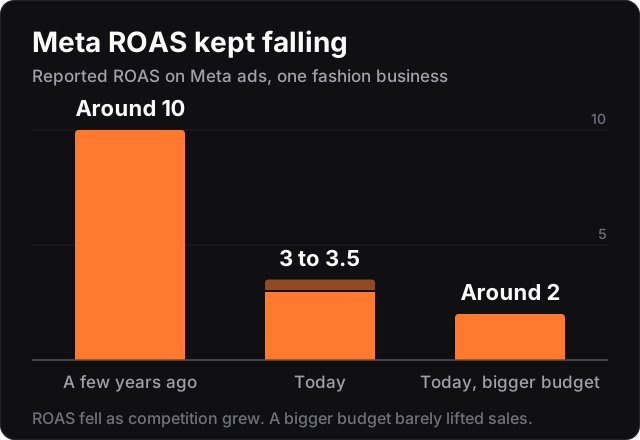
Of course, attributed ROAS does not necessarily represent actual incremental sales, a point we also made about comparing Shopee GMV Max with older keyword ads. But if the additional advertising spend is not generating meaningful new revenue, what exactly are we achieving by spending more?
This made me question whether the growth strategies we became used to during the pandemic are still appropriate for today's market.
What happens to inventory, staff and fixed costs if GMV falls?
Inventory, staff and fixed costs should be adjusted to the size at which the business makes money, not kept at a size that sales then have to support. Some people might argue that reducing GMV creates other problems. What happens to inventory? What about employees? What about fixed operating costs?
My perspective is that these are exactly the things we should be willing to adjust:
- Inventory too high? Improve purchasing discipline and control replenishment.
- Organisation too large? Restructure where necessary, or redeploy people into other profitable channels.
- Higher marketplace spend no longer earning an attractive return? Allocate those resources elsewhere.
Why should we maintain a certain business size and then struggle to generate enough profit to support it? Shouldn't we first determine how the business can make money, and then decide what operating scale makes sense?
When should a brand still scale?
A brand should still scale when the next block of sales adds profit, not just GMV. I am not suggesting that businesses should stop growing. The test is incremental profit: the change in total profit that comes with the extra sales, after product cost, platform fees, advertising, affiliate commission, vouchers and fulfilment.
| Extra sales | Change in profit | Decision |
|---|---|---|
| RM100,000 | +RM10,000 | Scale |
| RM100,000 | -RM5,000 | Do not chase it |
If an additional RM100,000 in sales generates RM10,000 in incremental profit, I would absolutely consider scaling. But if generating another RM100,000 in sales actually reduces profit by RM5,000, why should we pursue it?
Is a smaller GMV always a worse year?
No. A year with less GMV and a profit can be better than a year with more GMV and a loss. The challenge is that once a business reaches a certain size, GMV can become a psychological burden.
If a company generated RM30 million last year but only RM20 million this year, many people would immediately call that a decline. But what if the company lost RM1 million on RM30 million in sales last year, and made RM2 million in profit on RM20 million this year?
| Example | Last year | This year |
|---|---|---|
| GMV | RM30 million | RM20 million |
| Profit | Loss of RM1 million | Profit of RM2 million |
| Profit per RM100 of sales | About -RM3.33 | RM10 |
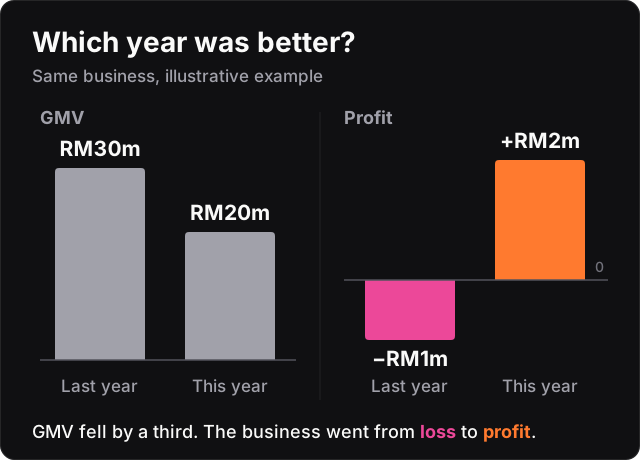
Which year was actually better?
After years of building an e-commerce business, through rapid growth, expansion, fundraising, inventory challenges and cash flow pressure, I have gradually come to realise that growth should not be pursued simply for the sake of growth.
Does this mean brands should leave Shopee, TikTok Shop and Lazada?
No. I still believe there are large opportunities on Shopee, TikTok Shop and Lazada. Marketplaces remain important channels for customer acquisition, brand discovery and sales, which is why we argued that brands should still sell on them despite the fees.
But that does not mean every channel must be scaled to its maximum potential, especially when the additional volume comes at the expense of profitability.
What is the new rule for e-commerce growth?
The new rule for e-commerce growth is to work out how the business makes money first, and only then decide how much GMV to chase. Looking back at that conversation, I realised that one of the biggest changes in my own business philosophy fits in 2 sentences.
In the past, we decided how much GMV we wanted to achieve, then figured out how to make money. Today, we should first figure out how to make money, then decide how much GMV we want to achieve.
| The old way | The new way | |
|---|---|---|
| Start with | How much GMV do we want? | How does the business make money? |
| Then | Work out how to make money at that size | Decide how much GMV is worth chasing |
| Success means | A bigger GMV number every year | Profit you can sustain |
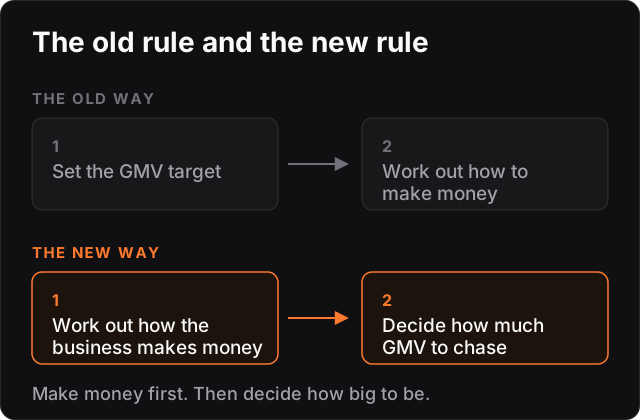
I used to think that building a bigger business naturally meant building a more successful one. Looking back now, I think what matters more is knowing when to accelerate, when to slow down, and when it might even be necessary to deliberately reduce the size of a business.
When should a business stop pushing for growth?
When the extra sales no longer add profit. Judging that moment well is not something I figured out entirely on my own.
Over the past year or two, I have had the chance to spend time with several successful entrepreneurs in their 60s, learning from their experience and perspectives. One thing I have gradually noticed is that their strength is not simply knowing how to grow a business. It is knowing when to push forward, when to protect what they have built, and when to stop.
That kind of judgement is also an important entrepreneurial skill, and it often comes with experience.
After all, we started our businesses to build something sustainable, not simply to produce a more impressive GMV scorecard every year.
Frequently asked questions
What does chasing GMV mean in e-commerce?
Chasing GMV means setting sales targets first and spending whatever it takes to reach them: more advertising, deeper vouchers, more affiliates, more SKUs and more stock. It treats a bigger sales number as success, even when the extra orders earn little or lose money after platform fees and marketing costs.
Is GMV growth bad for a brand?
No. Growth is good when each extra block of sales adds profit. It becomes a problem when the extra volume costs more in advertising, fees, discounts and operations than it earns, so the business gets bigger and less profitable at the same time.
How do I know if extra sales are profitable?
Look at incremental profit: the change in profit that comes with the extra sales, after product cost, platform fees, advertising, affiliate commission, vouchers and fulfilment. If an extra RM100,000 of sales adds RM10,000 of profit, it is worth scaling. If it lowers profit, it is not.
What should e-commerce brands measure instead of GMV?
Brands should measure profit alongside GMV, at 2 levels. Contribution margin is what is left from each order after product cost, platform fees, advertising, affiliate commission and fulfilment, as in our RM100 order example. Incremental profit is the change in total profit that comes with each extra block of sales. GMV still matters, but as the result of growth that pays for itself, not as the target.
Why does ROAS fall when I increase my advertising budget?
ROAS, or return on ad spend, is the sales an ad platform credits to ads for every RM1 spent. It tends to fall over time as more brands compete for the same audiences, and pushing the budget higher can make it fall further, because the extra spend often brings in few extra sales. Reported ROAS is also an average across the whole budget, so the extra ringgit usually returns less than the headline figure. And it is attributed rather than incremental: the platform credits sales to the ads, including some that would have happened anyway.
Should I cut ad spend if my ROAS keeps dropping?
Not automatically. First check whether the extra spend is producing extra sales and extra profit. If sales barely move when the budget goes up, that spend is better cut or moved to products and channels that still earn their keep.
Is a high ROAS the same as profitable growth?
No. ROAS only shows the sales an ad platform credits to ads for every RM1 spent. It does not show whether those sales would have happened anyway, and it leaves out product cost, platform fees, affiliate commission, vouchers and fulfilment. Growth is profitable only when the extra sales still add profit after all of those costs.
Is lower GMV with higher profit a better result?
Often, yes. Take the example in this post: a business that makes a RM2 million profit on RM20 million of sales this year is in a stronger position than it was last year, when it lost RM1 million on RM30 million, even though its GMV is a third smaller.
How can Labu-Labu help?
Labu-Labu is a Malaysia-based social-commerce and e-commerce enabler helping brands operate and grow across Shopee, TikTok Shop and other digital commerce channels. We look at advertising, platform fees, affiliates, inventory and profit together at SKU level, so growth goes where it actually makes money.
If you want to work out which of your sales are worth scaling and which are costing you, talk to us.