
Over the past 2 years, one question has become increasingly common among e-commerce operators in Malaysia: if marketplace fees keep increasing, does it still make sense to sell on Shopee and TikTok Shop?
Short answer: yes. But the role of a marketplace has changed.
A few years ago, many businesses could treat Shopee or TikTok Shop almost as their entire online business. The platform provided traffic, payment, logistics, trust and conversion. As long as the product had enough margin, sellers could grow together with the platform.
Today the economics are very different. Before advertising, affiliate commission or vouchers, a Fashion seller now pays roughly RM18.90 to RM22.68 in basic platform fees on every RM100 order, and up to RM24.84 inside Shopee's Cashback Programme. The marketplace is still where the demand is. It just can no longer be the whole business.
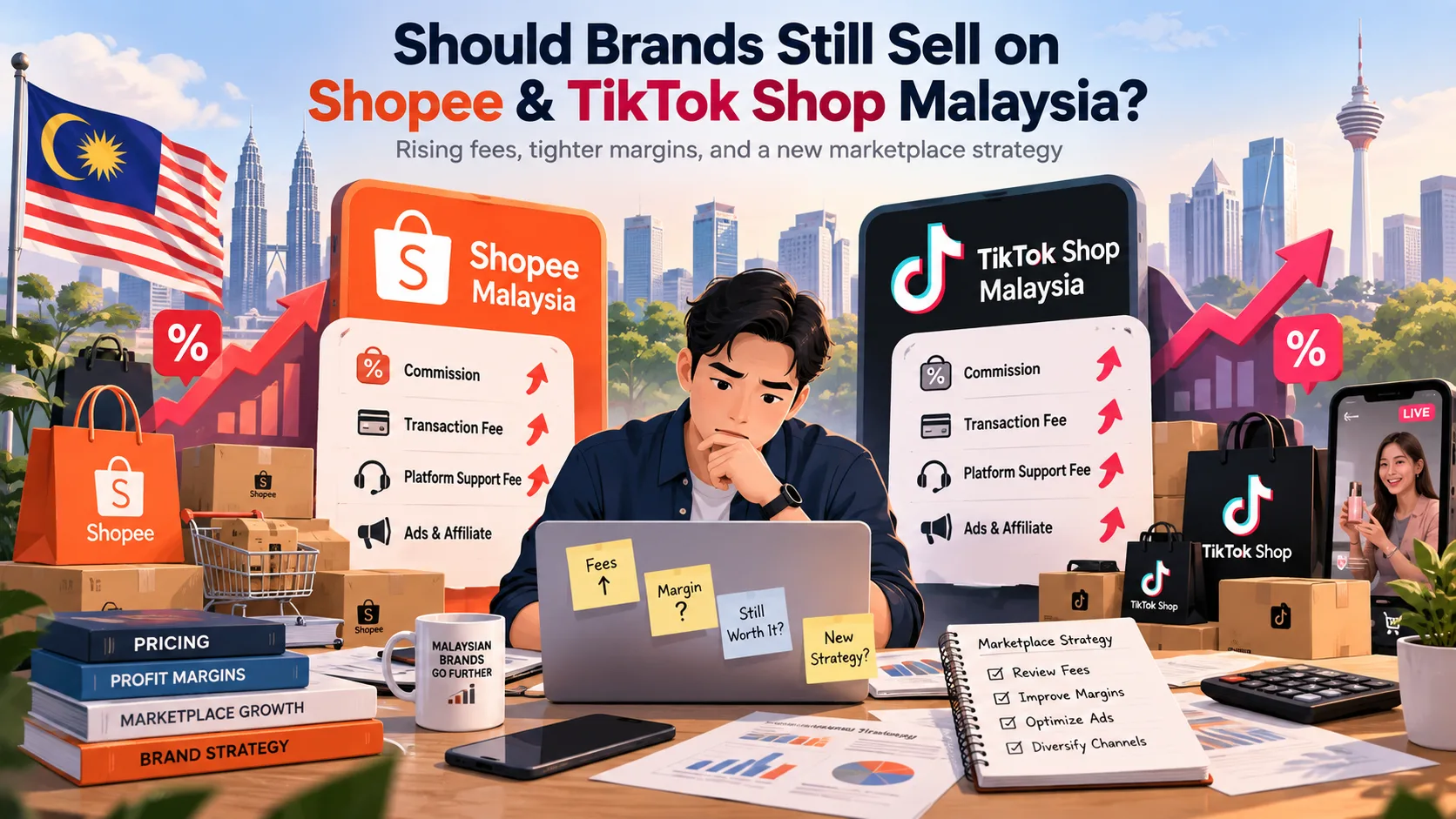
How much have Shopee and TikTok Shop fees risen since 2024?
This is not just a perception among sellers.
In its 2025 market review of the digital economy, the Malaysia Competition Commission (MyCC) recorded a 3 percentage-point commission adjustment across Shopee categories on 1 August 2024, while TikTok Shop made an average 4.8 percentage-point adjustment across categories on 5 September 2024. By March 2025, MyCC reported Fashion commission on Shopee Marketplace at 8% to 12% before Sales and Service Tax (SST), and TikTok Shop Fashion at around 7.5% to 9.5% before SST.
The adjustments did not stop there.
| When | Platform | What changed |
|---|---|---|
| 1 Aug 2024 | Shopee | Commission up 3 percentage points across categories. Transaction fee revised to 3.5% before SST |
| 5 Sep 2024 | TikTok Shop | Commission up an average 4.8 percentage points. Transaction fee from 2.16% to 3.78% |
| Mar 2025 | Both | Fashion commission: Shopee 8% to 12%, TikTok Shop 7.5% to 9.5%, before SST |
| 16 Jul 2025 | Shopee | New Platform Support Fee: RM0.54 per completed order |
| 13 Sep 2025 | TikTok Shop | Fashion commission 14.58% outside BXP, 10.26% in BXP, with SST |
| 15 Feb 2026 | TikTok Shop | New Platform Support Fee: RM0.54 per delivered order |
| Aug 2026 | Shopee | Fashion commission 14% to 17% before SST outside the Cashback Programme |
| 14 Aug 2026 | Shopee | Cashback Programme Fashion commission raised to 11.5% to 13.5% before SST |
| 7 Oct 2026 | TikTok Shop | Bonus Extra Program fee on campaign days rises to 7.02% with SST |
| 16 Oct 2026 | TikTok Shop | Transaction fee on PayLater orders rises to 4.86% |
What does a Fashion seller pay on Shopee and TikTok Shop in 2026?
By August 2026, Shopee's own seller guide listed Marketplace commission for Fashion at 14% to 17% before SST for sellers outside the Shopee Cashback Programme. Clothing sits at 14%, and most other Fashion sub-categories at 14.5% to 15%. From 14 August 2026, sellers in the programme pay a lower 11.5% to 13.5% commission, but also a separate Cashback Programme service fee of 5.5% before SST, or 7.5% on campaign days, capped at RM100 per item. Shopee also charges a transaction fee: its Terms of Service set it at 3.5% before SST from 1 August 2024, which Shopee puts at 3.78% with the 8% SST, on top of commission and programme fees. And since 16 July 2025 there has been a Platform Support Fee of RM0.50, or RM0.54 with SST, on each completed order, with exemptions for new sellers and low-volume shops.
TikTok Shop has moved in the same direction. Since 13 September 2025, its Marketplace commission for many Fashion categories has been 14.58% including SST for sellers outside the Bonus Extra Program (BXP), and 10.26% for BXP participants. The transaction fee is 3.78% including SST, up from 2.16% before 5 September 2024, and orders paid with TikTok PayLater move to 4.86% from 16 October 2026. Since 15 February 2026 there is also a Platform Support Fee of RM0.50 before SST, or RM0.54 with SST, per successfully delivered order, with some category exemptions and waivers for new and small sellers. BXP sellers pay a further 4.86% service fee on normal days, rising to 7.02% on defined campaign days from 7 October 2026.
Here is the same comparison with the 8% SST included. The programme rows refer to the Shopee Cashback Programme and TikTok Shop's BXP.
| Fashion fee, with SST | Shopee | TikTok Shop |
|---|---|---|
| Commission | 15.12% to 18.36% | 14.58% |
| Commission in programme | 12.42% to 14.58% | 10.26% |
| Programme fee | 5.94%, campaign days 8.1% | 4.86%, campaign days 7.02% |
| Transaction fee | 3.78% | 3.78% |
| Support fee per order | RM0.54 | RM0.54 |
What does that mean on a RM100 order?
Take a simple RM100 Fashion order as an illustration.
| Seller | Fees included | Total |
|---|---|---|
| Shopee, standard | 15.12% to 18.36% commission, 3.78% transaction fee, RM0.54 support fee | RM19.44 to RM22.68 |
| Shopee, Cashback Programme | 12.42% to 14.58% commission, 3.78% transaction fee, 5.94% programme fee, RM0.54 support fee | RM22.68 to RM24.84 |
| TikTok Shop, standard | 14.58% commission, 3.78% transaction fee, RM0.54 support fee | RM18.90 |
| TikTok Shop, BXP | 10.26% commission, 3.78% transaction fee, 4.86% BXP fee, RM0.54 support fee | RM19.44 |
| TikTok Shop, BXP campaign day | 10.26% commission, 3.78% transaction fee, 7.02% BXP fee, RM0.54 support fee | RM21.60 |
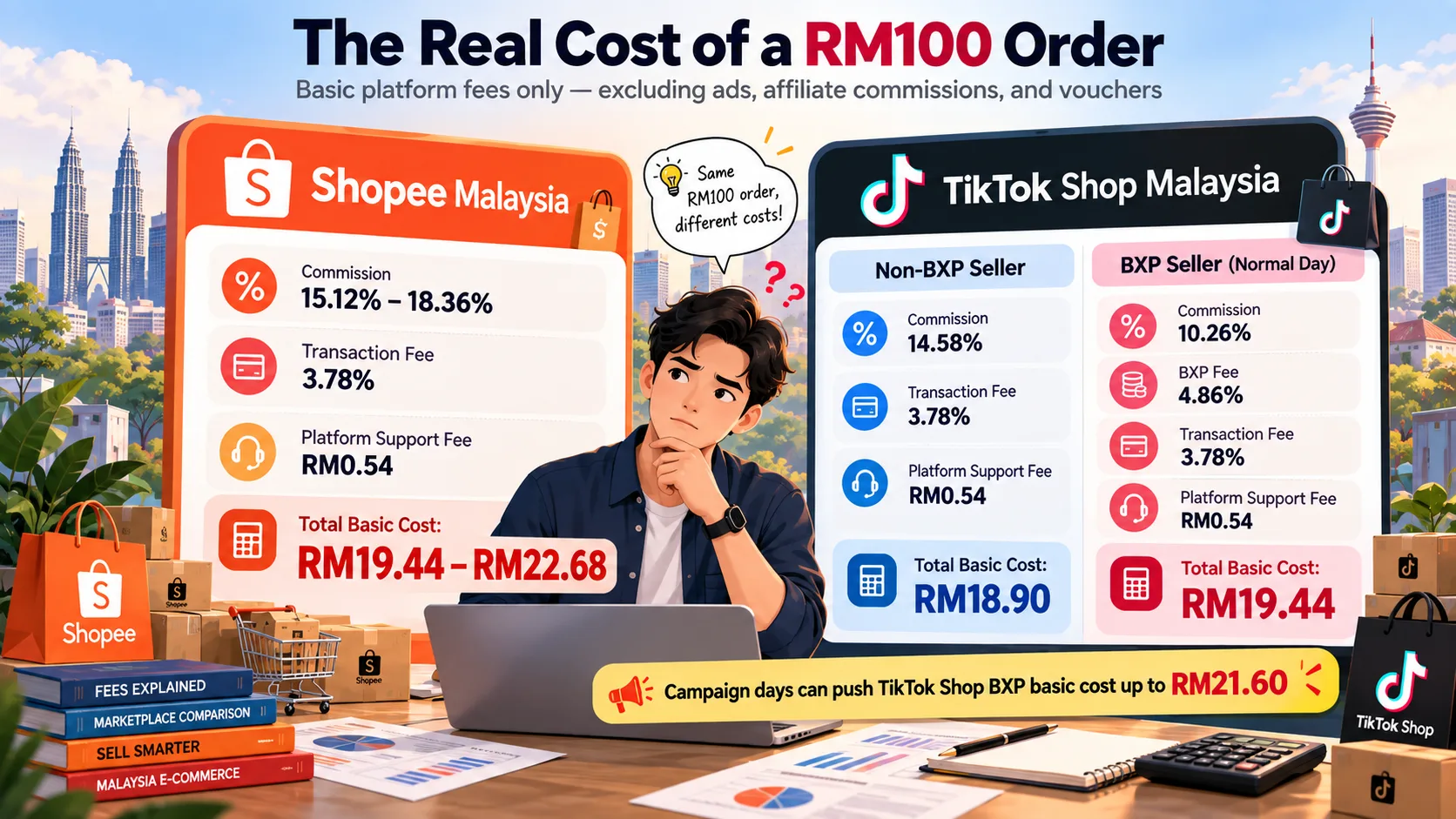
For a clothing seller outside the Cashback Programme, Shopee's 14% rate puts the cost at the bottom of that range, RM19.44. Joining a platform programme lowers the commission but adds a service fee, so it does not make a seller cheaper on these fees alone. On Shopee campaign days the Cashback Programme fee rises to 8.1% with SST, which adds another RM2.16 per RM100 order.
None of these examples include advertising, affiliate creator commissions, seller-funded vouchers or additional promotional programmes. That distinction is important.
Do Shopee and TikTok Shop charge 30% commission?
No. It would be inaccurate to say that Shopee or TikTok Shop simply "charges 30% commission". They do not.
But once commission, transaction fees, programme fees, advertising, affiliates and seller-funded promotions are combined, an effective marketplace cost above 30% is entirely possible for an active seller.
So why are businesses still selling there?
Because Shopee and TikTok Shop still solve a very important problem: demand.
Millions of consumers already open these apps with purchasing intent. As we noted in an earlier post on marketplace fees, Ipsos found that 71% of Malaysian e-commerce buyers had shopped on Shopee and 62% on TikTok Shop.
The marketplace provides discovery, payment infrastructure, logistics integration, reviews, buyer protection and trust. For a new product, it can provide immediate access to customers. For a winning product, it can provide scale. For slow-moving inventory, it can create liquidity. For a new business without an existing customer base, reproducing all of this independently would be expensive.
So the conclusion should not be "marketplace fees are getting expensive, therefore we should leave marketplaces". That misses the point. The better question is: what role should marketplaces play in the business?
Should the marketplace be your whole business, or an acquisition channel?
The biggest strategic mistake today is treating the marketplace as the entire business. Instead, think of Shopee and TikTok Shop as customer acquisition and transaction channels.
The first purchase can happen on Shopee. The first discovery can happen through TikTok. There is nothing wrong with that. In fact, it may be the most efficient way to acquire the customer.
The problem begins when a business has to pay the same acquisition economics every single time the same customer purchases again. If every repeat purchase requires another round of commission, advertising, affiliate fees and discounts, customer acquisition never truly becomes cheaper.
That is why customer relationship management (CRM), retention, membership, content, community and owned channels become more valuable as marketplace costs rise. Marketplace brings traffic. The business still needs to build the relationship.
Why manage contribution margin instead of GMV?
Another change is required internally. GMV, or gross merchandise value, is becoming a dangerous metric on its own.
Imagine a RM100 product:
| On a RM100 order | Amount |
|---|---|
| Product cost | RM50 |
| Platform fees | RM20 |
| Advertising and affiliate cost | RM10 |
| Fulfilment and operating cost | RM5 |
| Contribution left | RM15 |
Now imagine increasing sales from RM1 million to RM5 million. The GMV chart goes up and to the right. But if advertising becomes more expensive, returns increase or discounts become deeper, that RM15 can easily become RM5, or zero.
Growth without contribution margin is simply larger activity.
Every marketplace operator should therefore understand profitability at SKU level:
- Which SKU can afford affiliate commission?
- Which SKU can afford GMV Max?
- Which SKU should join major campaigns?
- Which product should be used mainly for customer acquisition?
- Which product should not be scaled, even if ROAS looks attractive?
These questions matter much more today than simply asking "how do we increase marketplace GMV?".
Does every product need the same marketplace strategy?
No. As marketplace economics become more expensive, assortment strategy becomes more important. A business might give different products different jobs:
| Product type | Marketplace role |
|---|---|
| Competitive hero products | Attract new customers |
| High-conversion products | Distribute aggressively through affiliates |
| New products | Test quickly with marketplace traffic |
| Slow inventory | Clear through promotions |
That does not mean every SKU needs the same pricing, advertising budget, affiliate commission or campaign participation. Marketplace management is increasingly a portfolio management problem. The operator is no longer simply buying advertisements. The operator is deciding where to deploy margin.
Why do higher marketplace costs make brand building more important?
When the cost of distribution increases, some businesses respond by competing even harder on price. That can become a trap.
If consumers only know the product as "the RM29 shirt" or "the cheapest bottle on Shopee", another seller only needs to be RM2 cheaper to take the customer.
A stronger brand creates a different behaviour. Instead of searching for the category, consumers begin searching for the business itself. That changes the economics. The stronger the direct demand, the less dependent a business becomes on repeatedly buying discovery.
This does not mean leaving Shopee or TikTok Shop. It means becoming strong enough that marketplaces are one distribution channel instead of the owner of your entire demand.
What is the new marketplace equation?
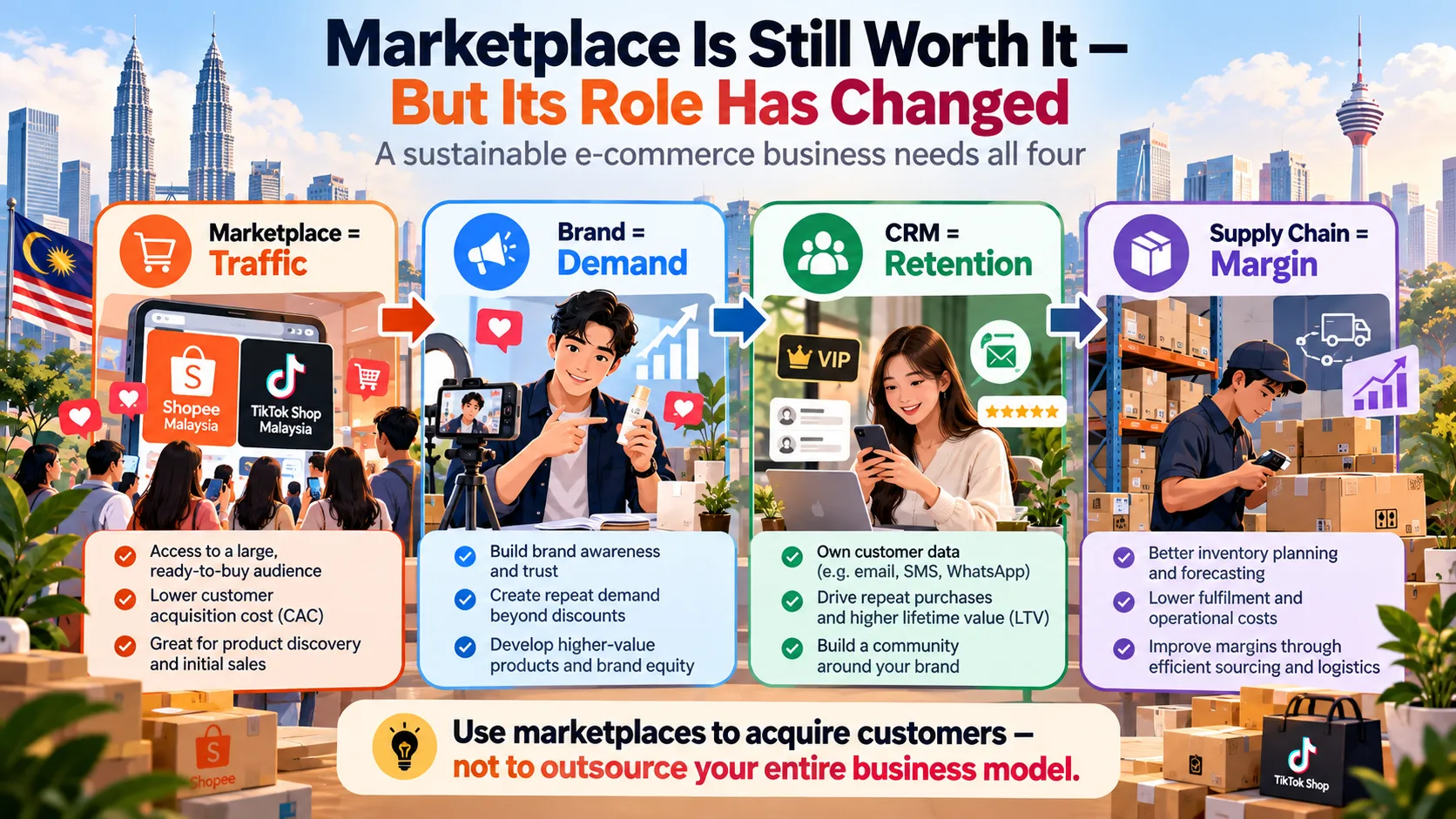
We think the modern e-commerce business can be understood through 4 layers:
| Layer | What it does |
|---|---|
| Marketplace = traffic | Shopee and TikTok Shop provide access to demand |
| Brand = demand | A strong brand creates customers who actively search for you |
| CRM = retention | Customer data, membership and communication increase repeat purchases and lifetime value |
| Supply chain = margin | Better sourcing, inventory turnover and product planning create the margin needed to survive rising distribution costs |
A sustainable e-commerce company needs all 4.
So should you still sell on Shopee and TikTok Shop?
Yes. For most Malaysian consumer businesses, ignoring Shopee and TikTok Shop would mean ignoring 2 of the most important online demand channels in the country. The opportunity is still large, and the platforms still provide real value. But businesses need to recognise that the economics have changed.
The old question was: how much GMV can we generate on Shopee and TikTok Shop? The better question today is:
How can we use Shopee and TikTok Shop to capture demand without allowing our entire business model to become dependent on their economics?
That difference may define which e-commerce businesses continue to grow profitably over the next few years.
Frequently asked questions
How much commission does Shopee charge Fashion sellers in Malaysia in 2026?
Shopee Malaysia lists Marketplace commission for Fashion at 14% to 17% before SST for sellers outside the Shopee Cashback Programme, with clothing at 14%. Programme sellers pay 11.5% to 13.5% from 14 August 2026, plus a Cashback Programme service fee of 5.5% before SST, or 7.5% on campaign days. All sellers also pay a 3.5% transaction fee before SST and a RM0.50 Platform Support Fee per completed order, and 8% SST is charged on top of every fee. New Marketplace sellers pay no commission for their first 120 days or 200 completed orders, whichever comes first.
How much does TikTok Shop charge Fashion sellers in Malaysia in 2026?
For many Fashion categories, including womenswear, menswear, Muslim fashion, shoes and bags, TikTok Shop Malaysia charges 14.58% commission including SST outside the Bonus Extra Program, or 10.26% inside it. On top of that come a 3.78% transaction fee, rising to 4.86% for PayLater orders from 16 October 2026, and a RM0.54 Platform Support Fee per delivered order. BXP sellers also pay a 4.86% service fee on normal days and 7.02% on campaign days from 7 October 2026.
What is the Platform Support Fee?
A fixed fee charged per successfully delivered order, regardless of order value. Shopee Malaysia introduced RM0.50, or RM0.54 with SST, from July 2025. TikTok Shop Malaysia introduced the same RM0.50, or RM0.54 with SST, from 15 February 2026, with some category exemptions and waivers for new and small sellers.
What does TikTok Shop's Bonus Extra Program cost a seller?
BXP sellers pay a lower commission, 10.26% instead of 14.58% for many Fashion categories, plus a separate BXP service fee of 4.86% on normal days, charged on every completed order from the shop. On a RM100 Fashion order that adds up to RM19.44 in basic platform fees, against RM18.90 outside the programme. On campaign days from 7 October 2026 the BXP fee is 7.02%, taking the total to RM21.60. TikTok Shop defines campaign days as the 3 days before each double-day sale plus the day itself, and the first 2 days of Payday.
Does Shopee or TikTok Shop take 30% of every sale?
No. Basic platform fees on a RM100 Fashion order work out at roughly RM18.90 to RM22.68 on a normal day, or up to RM24.84 inside Shopee's Cashback Programme. An effective cost above 30% becomes possible once advertising, affiliate commission and seller-funded promotions are added.
Should brands leave marketplaces and sell direct instead?
For most Malaysian consumer brands, no. Selling direct still needs paid customer acquisition, which can cost as much as the marketplace, as we set out in our earlier post. The better approach is to use marketplaces to acquire customers, then build brand, CRM and retention so repeat purchases do not pay the full acquisition cost every time.
How did we calculate these figures?
Marketplace commission rates vary by seller type, product category and participation in platform programmes. Rates and programme structures also change regularly. The calculations above are illustrative examples based on publicly available Malaysian fee schedules as of 5 October 2026, and should not be treated as a universal rate for every seller. They cover Marketplace sellers, not Mall sellers, whose rates are higher. Figures include the 8% SST unless stated as before SST. New sellers on both platforms get temporary waivers on some fees, which these examples ignore.
Sources:
- Malaysia Competition Commission, Market Review on the Digital Economy Ecosystem, Interim Report, March 2025, Tables 12 and 13
- Shopee Malaysia Seller Education Hub: Marketplace commission fees, transaction fee, Platform Support Fee and SST on fees
- Shopee Malaysia Terms of Service, clause 23
- TikTok Shop Academy Malaysia: commission fee, transaction fee, Platform Support Fee and Bonus Extra Program
How can Labu-Labu help?
Labu-Labu is a Malaysia-based social-commerce and e-commerce enabler helping brands operate and grow across Shopee, TikTok Shop and other digital commerce channels. We look at platform fees, advertising, affiliates and inventory together at SKU level, so margin goes to the products that can earn it back.
If you want to work out what your marketplace fees are really costing, and which products can afford ads, affiliates and campaigns, talk to us.