
Are keyword ads still effective on Shopee?
Yes. Keyword ads can still work, especially when shoppers already know what they are looking for.
Someone searching for "blood pressure monitor", "running shoes" or a specific brand name is showing much stronger purchase intent than someone casually browsing a marketplace homepage. That demand still has value.
But something bigger is changing. Keywords are not disappearing. Manual keyword optimisation is becoming less important.
As platforms move towards AI-driven advertising systems such as Shopee GMV Max, advertisers are gradually losing control over individual keywords, bids and placements. Instead of asking "Which keyword should I bid on?", the more important question is becoming:
"Which product should I give the algorithm?"
That is a very different way of thinking about performance marketing.
Is search dying, or just changing?
Since ChatGPT launched in late 2022, there has been a lot of discussion about whether traditional search is dying. I don't think that is the right way to look at it. People are still searching.
Google itself continues to invest heavily in Search, AI Overviews and AI Mode. In its 2026 guidance for generative AI search, Google also stated clearly that traditional SEO fundamentals remain relevant, because its AI features still rely on Google's core search and ranking systems.
What has changed is what happens after the search.
In a 2025 Pew Research study, Google users who encountered an AI summary clicked a traditional search result in only 8% of visits, compared with 15% when no AI summary appeared.
Ahrefs later updated its own research using December 2025 data and found that the presence of an AI Overview correlated with a 58% lower average click-through rate for the top-ranking page, compared with similar informational searches without one.
So I would not say search is disappearing. I would say search is becoming less dependent on clicks.
In the past, the journey was simple:
Search → Results → Click → Website
Increasingly, it can become:
Question → AI Answer → Decision
And a similar transformation is happening inside marketplaces.
How is marketplace advertising changing?
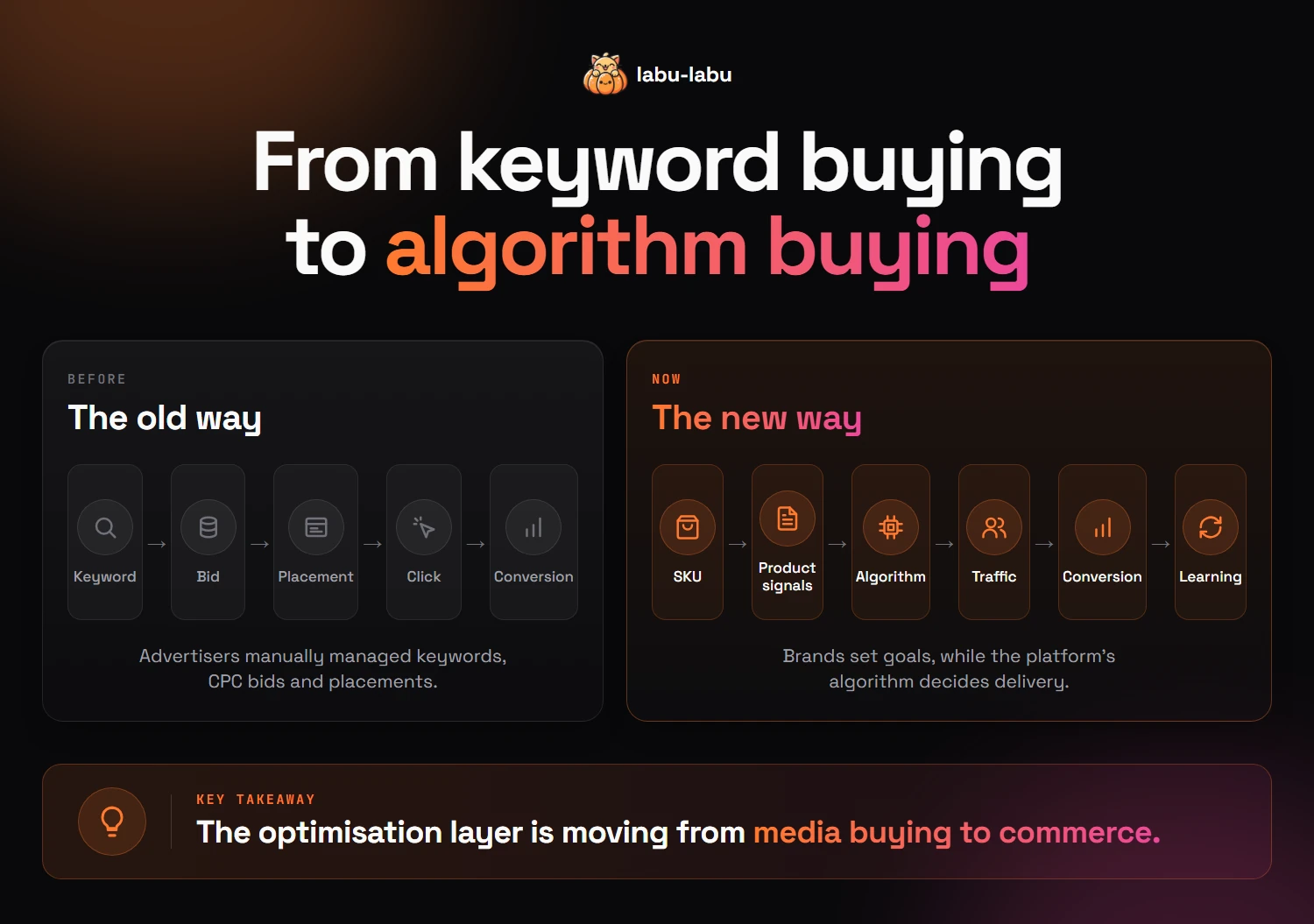
For many years, marketplace advertising looked similar to traditional search advertising. Brands selected keywords. We chose broad or exact match. We adjusted CPC bids. We monitored CTR. We removed expensive keywords and increased bids on profitable ones. The advertiser had a relatively large amount of control.
That model is changing.
Shopee Malaysia has explicitly stated that it is gradually phasing out Product Manual Ads and prioritising GMV Max, moving campaign optimisation away from individual keyword bidding towards automated systems based on budget and target ROAS.
This is not unique to Shopee. Across digital advertising, platforms are increasingly asking advertisers for 3 things:
- The product.
- The budget.
- The objective.
The algorithm then decides how to find the customer.
What is Shopee GMV Max?
GMV Max is Shopee's automated advertising solution, designed to optimise campaigns towards GMV and ROAS goals. Instead of manually selecting every keyword and setting individual bids, sellers mainly set a daily budget and a target ROAS. Shopee's system then manages more of the bidding, search-term matching and delivery automatically.
Importantly, this does not mean keywords are no longer relevant. It means advertisers are losing direct control over them.
According to Shopee, GMV Max uses an Auto Keyword strategy that considers signals including:
- Product title and listing content
- Buyer search intent
- Historical advertising performance and signals
Shopee also states that its system automatically identifies relevant search terms and placements, rather than requiring sellers to select each keyword manually.
So the better way to describe what is happening is: keywords are not disappearing. Keyword management is becoming automated.
Why do keyword ads still matter?
Because there is a big difference between demand capture and demand discovery.
Imagine someone searching "Omron blood pressure monitor". That shopper is already expressing very strong intent. A manual search campaign can be useful because the brand knows exactly which demand it wants to capture.
Traditional keyword advertising therefore remains useful when:
- Search intent is very specific
- The brand knows which keywords convert
- Branded search matters
- Certain high-value products need additional visibility
- The advertiser wants tighter control over particular search terms
Shopee Malaysia still provides Manual Ads for eligible Mall sellers.
So this is not a debate about "keyword ads good, GMV Max bad", or "GMV Max good, keyword ads dead". Both can have a role. The bigger question is where the competitive advantage now sits.
GMV Max vs manual keyword ads: how do they compare?
| Manual keyword ads | GMV Max | |
|---|---|---|
| What you set | Keywords, match types, CPC bids | Daily budget and target ROAS |
| Who picks keywords | The advertiser | Shopee's Auto Keyword strategy |
| Placements | More manual control | Chosen automatically by smart bidding |
| Availability in MY | Eligible Mall sellers | Prioritised by Shopee for product ads |
| Best suited to | Known high-intent and branded search terms | Broad discovery using platform signals |
| Main lever for you | Keyword and bid management | SKU, price, listing, reviews, offer and stock |
What can advertisers still optimise under GMV Max?
With traditional search ads, a performance marketer could spend hours working on keywords, match types, CPC bids, placements and negative or poor-performing terms.
Once more of those decisions move inside the algorithm, there are fewer advertising levers left to pull manually. But that does not mean optimisation disappears. It moves somewhere else.
And this is where I think many brands are still thinking about GMV Max incorrectly.
If the algorithm decides who sees the ad, when the ad appears and how aggressively to bid, then the quality of the product we give the algorithm becomes increasingly important.
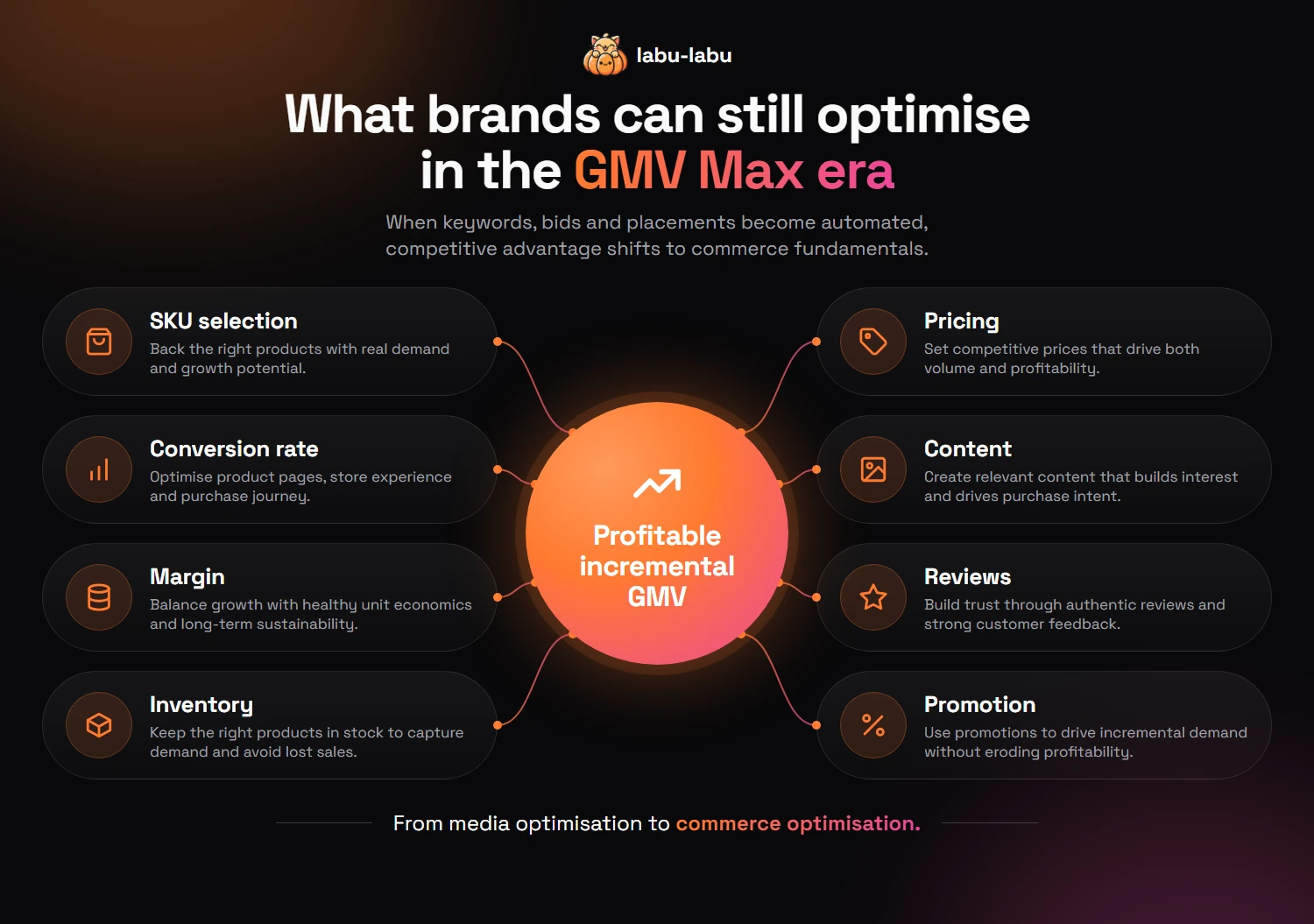
The new optimisation layer becomes:
- Product
- Price
- Content
- Conversion
- Reviews
- Promotion
- Inventory
- Assortment
This is no longer purely media optimisation. This is commerce optimisation.
If not "which keyword?", what is the most important question?
It may be: which SKU?
Imagine giving GMV Max 2 products.
Product A: good price, strong reviews, high conversion rate, healthy stock, a clear product title, attractive images and a good promotional offer.
Product B: weak reviews, poor images, low conversion, an uncompetitive price and limited inventory.
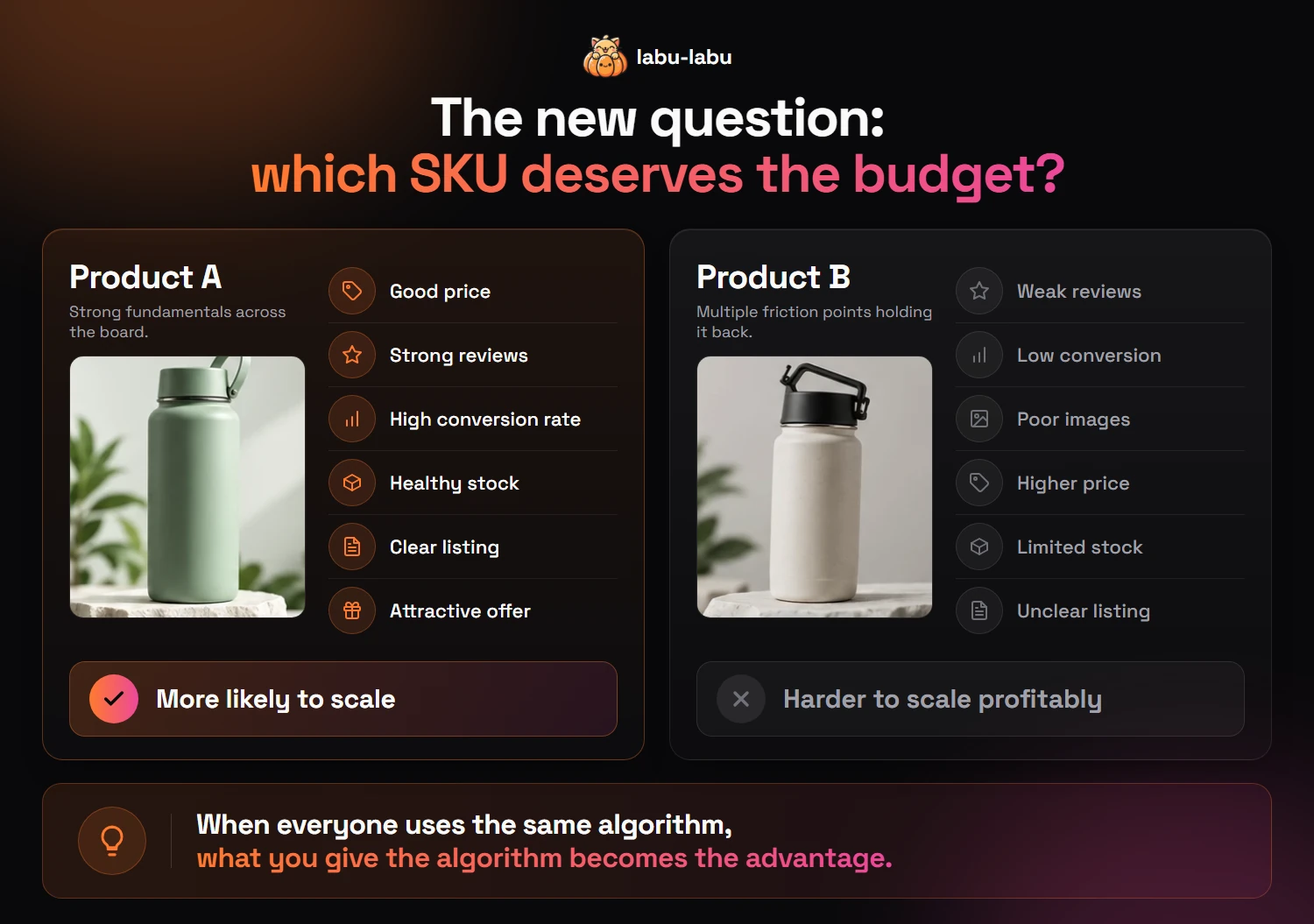
The advertising algorithm can bring traffic to both. But advertising cannot magically repair Product B.
Shopee's own advertising guidance advises sellers to pay attention to product images, titles, descriptions, reviews, ratings, sold count, pricing and promotions when improving advertising performance.
This is why I believe product assortment is becoming one of the most important parts of performance marketing on marketplaces. Instead of spending all our time asking:
"Which keyword should receive another RM0.10 CPC?"
We increasingly need to ask:
"Which SKU deserves another RM10,000 of advertising budget?"
That is a much bigger business decision.
Why does this move performance marketing from media to commerce?
This changes the role of an e-commerce team.
Previously, performance marketing could sometimes operate relatively independently. The marketing team bought traffic. The merchandising team handled products. The operations team managed inventory. The pricing team managed promotions.
Those functions can no longer be separated so easily. Because if GMV Max learns from conversion signals, then:
- A pricing decision affects advertising.
- A stock decision affects advertising.
- A product title affects advertising.
- Reviews affect advertising.
- A voucher affects advertising.
- SKU selection affects advertising.
Your merchandising strategy has effectively become part of your advertising strategy.
That is why we describe the shift as:
Media Optimisation → Commerce Optimisation
Can you compare GMV Max ROAS with old keyword ads ROAS?
Not directly. When brands compare old keyword ads performance with new GMV Max performance, the numbers may not be like for like.
Shopee Malaysia updated GMV Max for local sellers on 28 July 2026, moving the charging model from clicks towards views under an oCPM model.
GMV Max reporting still includes purchases made within 7 days of an ad click, but Product GMV Max can also attribute a purchase when a shopper sees an ad and buys the promoted product within 1 day.
That means a historical manual search ROAS of 6 and a current GMV Max ROAS of 10 do not automatically mean the new campaign is almost twice as effective.
- The attribution methodology has changed.
- The traffic mix may have changed.
- The placements may have changed.
- The algorithm may be capturing sales that would previously have been measured differently.
Brands should therefore avoid judging advertising performance on one dashboard number alone. ROAS is important. But we should also ask:
- Is this incremental GMV?
- Is the SKU profitable after platform fees, vouchers, affiliate commissions and advertising?
- Would some of these sales have happened without the ad?
- Are we acquiring new customers, or repeatedly advertising to existing demand?
A higher reported ROAS is useful. A higher profitable incremental GMV is better.
Do the platform and the brand want the same thing?
Not always.
The marketplace wants to maximise transactions across its ecosystem while allocating advertising inventory efficiently. The brand wants to maximise profitable growth. These goals overlap, but they are not exactly the same.
An algorithm may be very good at finding the easiest conversions. But the easiest conversion is not necessarily the most valuable business outcome for the brand.
For example, a brand might want to:
- Launch a new SKU
- Reduce ageing inventory
- Acquire a new customer segment
- Push a higher-margin product
- Build a particular category
- Protect branded search
- Increase repeat purchases
Those are business objectives an advertising algorithm may not fully understand unless the commerce strategy around it is designed correctly.
That is why brands still need people. Automation does not remove strategy. It makes strategy more important.
Should brands still test manual keyword ads?
For eligible brands, yes. Especially when there is a clear hypothesis, for example: "We believe this SKU has strong search demand for these specific high-intent keywords."
Run the test. Set the budget. Measure the result. Compare it against GMV Max.
But do not assume in advance that manual search ads will produce a better ROAS simply because you have more control. And do not assume GMV Max is better because the dashboard shows a higher ROAS. Test both against the actual business objective.
The question is not "Which advertising product is better?". The better question is:
"Which advertising approach produces the most profitable incremental sales for this SKU?"
What should brands optimise in the GMV Max era?
If we can control fewer advertising variables, we should spend more time improving the variables we still control.
At Labu-Labu, we think about this at SKU level. Before asking whether to increase the advertising budget, we ask: is this the right product to scale?
- CTR: do shoppers want to click?
- Conversion rate: do shoppers buy after clicking?
- Price competitiveness: is the offer attractive compared with alternatives?
- Ratings and reviews: does the listing have enough trust?
- Content: do the title, images and description communicate the product clearly?
- Promotion: does the voucher or bundle improve the offer?
- Margin: can the product afford additional advertising?
- Inventory: if the algorithm suddenly scales the SKU, do we have enough stock?
- Repeatability: can we replenish the product if it works?
This is where advertising starts connecting directly with merchandising, finance and supply chain.
Is the future of performance marketing product selection?
There was a time when a great performance marketer could create an advantage by being better at keywords: knowing which keywords to buy, how much to bid, where the cheap CPC opportunities were, and constantly adjusting campaigns.
Those skills still matter in certain advertising environments. But on marketplaces, automation is taking more of that work away.
The competitive advantage is moving upstream. From "How do I buy traffic?" towards "What should I sell to this traffic?"
Perhaps the most important skill for the next generation of marketplace operators will not be keyword optimisation. It will be assortment optimisation.
- Choosing the right products.
- Testing them quickly.
- Understanding conversion.
- Backing the winners with inventory.
- Removing budget from weak products.
- Continuously feeding the algorithm better products to sell.
Because when everyone has access to the same advertising algorithm, the algorithm itself is no longer your advantage. What you give the algorithm becomes the advantage.
Frequently asked questions
Are Shopee keyword ads still effective in 2026?
Yes. Keyword-based search ads can still be effective for high-intent searches, especially when shoppers are actively looking for a particular product, category or brand. However, Shopee is increasingly moving product advertising towards automated solutions such as GMV Max.
Is Shopee replacing Manual Ads with GMV Max?
Shopee Malaysia states that it is gradually phasing out Product Manual Ads and prioritising GMV Max. Manual Ads remain available to eligible Mall sellers in certain search ads formats.
Does GMV Max use keywords?
Yes, search terms still matter, but advertisers do not manually select keywords inside GMV Max. Shopee says its Auto Keyword strategy considers product titles, listing content, shopper search intent and historical advertising signals to match products with relevant searches.
Can I choose placements in GMV Max?
Shopee states that GMV Max automatically identifies placements using its smart bidding system. Advertisers therefore have less manual placement control than under traditional Manual Ads.
What can brands control in GMV Max?
Brands can still influence outcomes through their budget and ROAS settings, but some of the biggest performance levers increasingly sit outside the advertising dashboard: SKU selection, pricing, product listings, promotions, ratings, conversion rate and inventory.
Is GMV Max ROAS directly comparable with old keyword ads ROAS?
Not necessarily. Shopee Malaysia changed GMV Max's charging and attribution model in 2026. Product GMV Max campaigns can now include certain purchases from shoppers who viewed an ad and purchased within 1 day, in addition to click-based attribution. Historical comparisons should therefore be interpreted carefully.
Is GMV Max better than manual search ads?
There is no universal answer. Manual search ads may be useful when a brand has a clear high-intent keyword strategy, while GMV Max can use broader platform signals and automated optimisation to discover conversion opportunities. Brands should compare them on profitable incremental GMV rather than ROAS alone.
So are keyword ads dead?
Keyword ads are not dead. Search is not dead either.
What is disappearing is the idea that performance marketing is mainly about sitting inside an advertising dashboard and adjusting keywords all day.
As algorithms take over more of traffic buying, the role of brands and e-commerce operators moves closer to the fundamentals of commerce:
- Choose the right product.
- Create the right offer.
- Improve conversion.
- Keep enough inventory.
- Then give the algorithm something worth scaling.
That, more than any individual keyword, may determine who wins the next stage of marketplace advertising.
How can Labu-Labu help?
Labu-Labu is a Malaysia-based social-commerce and e-commerce enabler helping brands operate and grow across Shopee, TikTok Shop and other digital commerce channels. We look at advertising, pricing, listings, conversion and inventory together at SKU level, so budget goes to the products that deserve it.
If you are working out how to run Shopee ads in the GMV Max era, talk to us.